|
|||
| DMF Home | About DMF | Contact DMF | DMF Offices |
 | |||
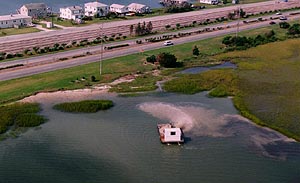
 | Shellfish Rehabilitation Program Creating New Fisheries Habitat North Carolina has the largest estuarine system of any state on the Atlantic coast - 2.2 million acres of sounds, tributaries, marshes and wetlands. Although, shellfish are found in most coastal waters of the state, the Division of Marine Fisheries (DMF) has found that more oysters and clams can be produced by creating more habitat. This is how it works: |
| For the first three weeks of an oyster's life, it is a free-swimming animal that is carried about by currents. After the third week, the oyster sinks to the bottom and must attach itself to a clean, hard surface in order to survive. That is why oysters are found growing attached to one another in beds, on bridge pilings, or other hard underwater surfaces. | 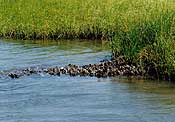 |
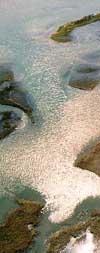
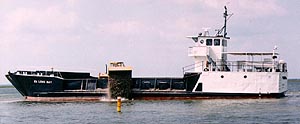
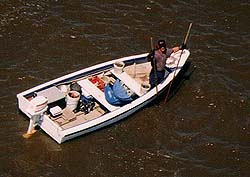 During the summer months, the DMF “plants” shell and rock (called cultch) to provide additional habitat for larval oysters and clams. Large vessels transport the cultch out to a designated site, and the shells are either dumped off with a front end loader or sprayed off with a high-powered hose. Approximately 500,000 bushels of cultch material are planted annually. |
|
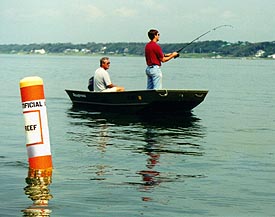 | Not only are these planting sites beneficial to oysters, they also provide habitat and protection for clams, juvenile finfish, crabs and small marine organisms. Larger fish tend to congregate around these sites, feeding on the smaller fish and marine life.
Planting sites are located in coastal waters from Dare to Brunswick counties, to provide additional fishing opportunities for both commercial and recreational fishermen. In order to promote increased oyster production, some of these planting sites are designated as oyster sanctuaries, where bottom disturbing gear and commercial fishing are prohibited. |