
Habitat Home
Coastal Habitat
Protection Plan
(CHPP)
CHPP Recommendations
Habitat Information
Habitat Mapping &
Monitoring
Documents and Downloads
New documents
added Feb. 2009
Contact Us
CHPP Steering Committee
Related Links
Habitats
Water Column
Shell Bottom
Submerged Aquatic
Vegetation
Wetlands
Soft Bottom
Ocean Hard Bottom
Threats to Habitat
|
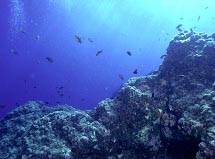 OCEAN HARD BOTTOM OCEAN HARD BOTTOM
Also known as reefs or live bottom.
Ecosystem enhancement
Hard bottom provides hard complex vertical structure for attachment of sponges, seaweed, and coral, which in turn support a diverse reef fish community.
Fish use of hard bottom habitat
- As many as 47 reef fish species inhabit nearshore ocean reefs (less than 60 ft. deep), and twice that number use offshore reefs. Many more invertebrates and fish also occur there.
- Hard bottom provides numerous hiding places for small and juvenile reef fish such as gobies, gag, black sea bass, and pigfish.
- King mackerel forage over the reefs, while adult gag, black sea bass, and snappers hunt among the structure
- Many species that live on hard bottom, also spawn there. Examples include black sea bass, grouper, gobies, and damselfish.
- Some hard bottom species, such as black sea bass and gag, live in the coastal estuaries as juveniles.
Some important facts
- The many wrecks off North Carolina (“graveyard of the Atlantic”) now function as hard bottom. The DMF also has an Artificial Reef program that adds new hard bottom areas to the system.
- More than 90% of the hard bottom off North Carolina occurs south of Cape Lookout, some very close to shore. (See habitat mapping and monitoring).
- This habitat is also called “live rock” because of the abundance of plants and invertebrates that attach and cover it.
How’s it doing?
Hard bottom locations have been partly mapped but no habitat trends data are available. It is thought to be in relatively good shape. See Threats to Habitat Index for more information
See Hard Bottom chapter of CHPP (PDF)
|


